Tag Archive | "running"

Happy Run

Running With Cancer – Part 3 One Day At A Time


Note: I’m writing a series on my bout with ovarian cancer and how my running was affected by it and helped me deal with it. You can read Part 1 for a little history on my running and cancer here and Part 2  for a look at how I planned my running while going through chemotherapy here.

Note #2: Today is World Cancer Day. I wish more than anything that we didn’t need a day for this terrible disease. I am a survivor of Ovarian Cancer and the color for that is Teal but today I am Purple to support World Cancer Day.

I wish I could describe how horrid chemotherapy is but until you go through it, you can’t know what it’s like really. I had to take a class at the cancer center before I started and they gave me a long list of symptoms that I would have to manage, foods I could eat, foods/liquids I should avoid, what medication I could/couldn’t take, daily tasks that I would need to do, how each round I would need to do blood work, it went on and on. It was overwhelming and scary.

Then I started chemotherapy and WHAM! I felt like I had been hit with a bus. Even with chemo school, I wasn’t prepared. Chemo made me feel like I was losing me – that my mind and my body were…not all there. I can’t explain it.

I had arrogantly thought I would be strong through it and continue to have a normal life. Ha! That was a wake up call. You feel loopy and foggy and so tired you feel like your bones are noodles. Food tastes horrid and you learn really fast that you have to be careful what you eat or you will have issues…with nausea, diarrhea, or constipation. Even with taking multiple meds for it, nausea reared it’s ugly head and would be a constant companion for the first week after chemo. My skin felt like it was crackling. I had to start taking a shot for my white blood cell counts and it made my bones ache like arthritis. I had trouble focusing and I couldn’t remember words and names. I did things like turn the stove on high instead of turning it off or putting my cat’s litter box lid on backwards. They call it Chemo Brain and when you pride yourself on being a smarty (some people would say smartass), not being able to remember a word or forgetting why you walked into a room is scary. Add all that up plus the fact that I was moving so slow and I felt like I had aged 40 years overnight!

And did I mention I lost my hair? God, how I miss my curls. I miss my pony tails I used to wear when I ran!

I know what you are thinking. A 45 year old woman should not be wearing her hair in pony tails. But to me, running was the fountain of youth. I didn’t start running until I was 40. People (non runners) would tell me running was bad for my knees but I felt better and healthier at 40 than I did in my 20s and 30s. Way healthier. Like I could conquer the world. On foot. 🙂 Running was fun and it made me feel like a kid again.

Running, for me, is most fun when I’m running fast! I had been running soooo slow and easy since I started back after surgery to be careful and not tire myself out. I’d had moments of what it felt like to be fast when I was running trails and would get to a fun downhill section. I didn’t push the pace for long but it was enough to make me smile. For the most part though, I was running slow. And when I say slow, I mean 12-14 minute miles…slow for me anyway.

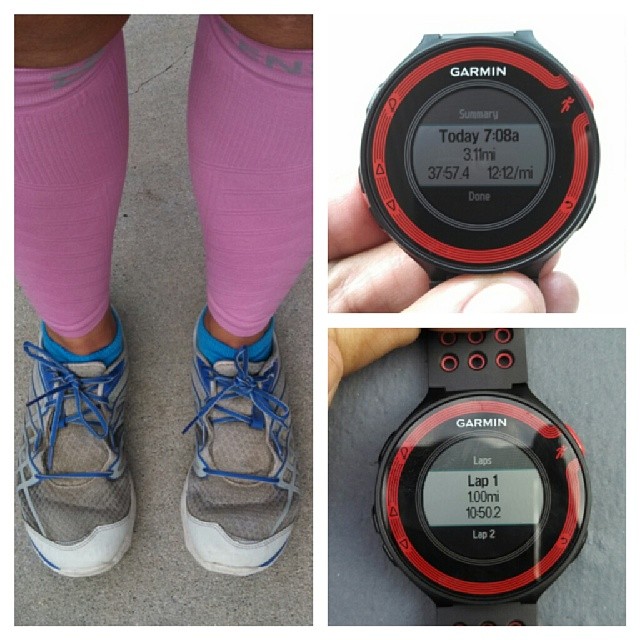
But last Saturday, I felt like seeing how fast I could run a mile. I wasn’t going all out but I wanted to get into the 10-11 min mile range. During my 5K, I pushed it and did a 10:50 mile! Woo! Happy Dance time!

I knew I had to be sensible about my training but I figured I could start laying a good base for when I could really train again. I had already bought a couple of pilates and yoga DVDs and pulled out my weights and started working on my whole body (I couldn’t do any core work or lifting for 3 months after the surgery). I had lost what little muscles I had before and now I was ready to build a stronger all around Lisa. But wow, pilates (I haven’t tried yoga yet) and weights was tough. And not as much fun as running but I am determined to do them and see if they help me get stronger. One thing for sure, I am not flexible at all, right now. At. All. For sure, I need to work on that.

For motivation to keep up with the pilates and weight training, I made a goal to try climbing by the end of the year! Yikes! It’s one of the things I’ve always wanted to try but was a little scared of. No more sitting around waiting and wishing for things. You have to get out there and do it. I also signed up for the Leading Ladies Marathon in August. I think I can be ready by then. I don’t know how fast I’ll be but I’m sure I can complete it. I had hoped I could PR but that might be wishful thinking, I hear. I’m sure I’ve seen other runners who are battling cancer run half marathons and marathons. I think. Haven’t I? I had looked for an ovarian cancer support group when I found out I had cancer but there wasn’t one near me. What I really wanted though was a Runner’s With Cancer support group so I could see how others were dealing with it and what they were doing.

I also wanted a coach who trains cancer patients. I wish I’d had one from the beginning. I didn’t think they existed but I had a couple of Twitter conversations with some other cancer survivors about that and it turns out there are coaches who are trained for that! Who knew! Thanks to @RunEatWriteRun and @AleneGoneBad who let me know that the American College of Sports Medicine offers a certification for that. And they have a Pro Finder to help you search for coach with that certification in your state! How cool is that?! Too bad I didn’t know about this last November instead of when I’m almost done with chemo. It might have helped me do the Tinkerbell Half that I’d had my heart set on. But then probably not since it fell on one of my hardest chemo round days. Sigh.

Anyway, I start round 5 of chemo on Thursday and will probably miss some days of working out. I think that having my scheduled interrupted  is one of the most frustrating things as a runner. Routine is key, I feel, toward succeeding at a goal. A routine without chemo will be bliss. I can’t wait until February is over.

But for now, I’m just taking it one day at a time.

***

Check back soon for the next chapter in my running with cancer journey! And don’t forget, if you missed Part 1 or Part 2, you can read them here:

Running With Cancer – Part 1
Running with Cancer – Part 2 The “Moderate” Runner?

If you’ve been through cancer and chemotherapy and are a runner, I would love to hear how it went for you. Please let me know in the comments or email me at the link below.

Posted in RunningComments (0)

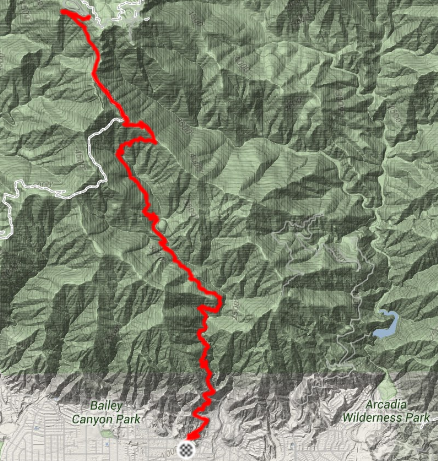
Mount Wilson Elevation Profile – Run It Fast

My Day Running Up and Down Mount Wilson

Mount Wilson Summit Run – Sierra Madre, California
January 30, 2014

The stresses of life and letdowns from others can often beat us up and tear us down in our day to day life.

On Thursday I needed an escape. I needed a mountain to pound  against and wrestle with until my body was beat down and my head was clear.

I’ve been trying to maximize and find all the beautiful, wonderful, and amazing places to train and run in and near Los Angeles over the past few months.

So a couple of nights ago I was searching maps and googling different searches and found Mount Wilson. Every review I read about it talked about how serious a ‘hike’ it was and one reviewer described the climb as ‘hell on earth.’ Well after reading that I found myself at the base of Mount Wilson less than 10 hours later. It was about a 40 minute drive from Hollywood.

I knew the climb up to the summit of Mt. Wilson was roughly a 4,500-5,000 foot gain over the course of give or take 7 miles.

By the time I parked it was already 2:15pm which didn’t leave too much daylight to run/hike up to the top and run back down. The day was already void of sun as it was extremely overcast, foggy, and full of dark clouds. I knew I’d have to Run It Fast® up and back down to beat the dark on what was an unfamiliar trail.

Running Up Mount Wilson

I started up the trail and immediately saw a guest book/log and wrote out ‘Joshua Ho…’ before the pen dried out. I had on a hydration vest with two bottles and hoped it wasn’t a prelude to my own hydration fate up on the mountain.

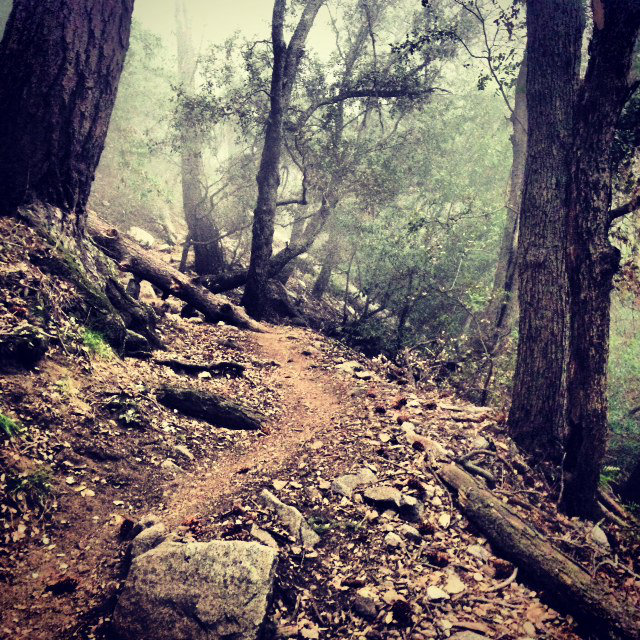
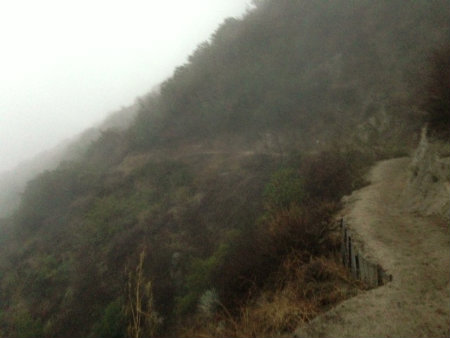
Half a mile into the trail, I saw the last human I’d see over the next 3+ hours. I’d love to tell you the views were beautiful the higher I climbed, but I couldn’t see anything after 1,000 feet of climb up the mountain (see below).

The climb up Wilson was no joke. I was able to run portions of it the first 3.5 miles and fast hike the other parts. After about 3.5 miles it became even more steep as the thick fog and dark clouds started to circle around me. I had my first thoughts of not being to get back down before it was dark and the rains set in.

The temperatures started to drop and the misty rain started to come down faster 4 miles in. I was running in a cut-off shirt and started to think that it might get too wet and cold before I reached the summit. As I mentioned earlier, no humans were anywhere to be found, especially this high up on the trail. I debated turning back as my hamstrings and back were starting to ache. However, I kept marching forward and feeling more and more liberated and free the higher I escaped into the clouds. I wasn’t done battling the mountain, and I’d regret not finishing if I turned back prematurely.

The 5th mile up the mountain had over 900 feet of gain and seemed to go on forever. I could never see too far ahead due to lack of visibility, but the trail before me, where I was watching every single step I planted, was beautiful and rich with character.

The next two miles averaged about 600 feet of climb per mile, but almost felt relatively flat after that 5th mile. About 6 miles up the trail I hit a rough jeep road that I made pretty good time on. The last 1.3ish miles to the summit were on this road.

The first half of the climb up Mt. Wilson was a serious climb, but most runners/hikers in decent shape can do it. The last half (after the first 3 miles) gets very krunk. It’s technical, very steep, and desolate in nature. I’m sure most days there is a bit more, or at least some, traffic on the trail higher up towards the observatory, but there was none when I went up it. I kept wondering what wildlife hid behind the next turn or behind the fog, but all I came across were a few squirrels and birds.

The Summit of Mount Wilson

It took me 2:03:11 to reach the top of Mount Wilson. The distance from where I started at my car to the top was clocked at 7.3 miles. The total climb per Strava was listed just a hair above 5,000 feet to a point of 5,665 of elevation.

The top, as I had read elsewhere, was in fact anti-climatic. It was a welcome sight as I knew that the climbing was over and that I’d be running a lot faster back down the mountain trail to civilization. However the summit of Mount Wilson, it’s just a bunch of roads at the top, along with the observatory which was rather small, and not a single example of life.

Running Down Mount Wilson

The trip back down the mountain was a lot faster than the way up and therefore not worthy as of many words. It was a fast down that was at times too fast. Some of the more technical parts leave 2-3 inches to plant your foot or down the mountain to your death you go. So it was important to pay attention to every step and slow down and walk through some very tight passes.

The steep run down was refreshing and fast! I started to feel it in my quads half way down as they were starting to grow sore. The miles back down the mountain clicked off so much faster than the ones up it.

The flight down had of course 5,000 feet of descent and took 1:20:30.

Mount Wilson Run Details

Total Mount Wilson 14.7 mile run had 5,088 feet of climb and 5,088 feet of descent and took 3:20:41.

Mt Wilson Mile By Mile Ascent/Descent, Pace
Mile 1: +729 -70, 14:53
Mile 2: +686 -49, 15:47
Mile 3: +513 -42, 15:05
Mile 4: +718 -42, 18:42
Mile 5: +995 – 41, 21:40
Mile 6: +687 0, 18:51
Mile 7: +546 0, 17:01
Mile 8: +53 -404, 13:11
Mile 9: 0 -533, 9:56
Mile 10: 0 -952, 12:33
Mile 11: 0 -801, 10:24
Mile 12: +97 -480, 10:25
Mile 13: 0 -655, 9:50
Mile 14: +88 -683, 10:11
Mile 14.7: 0, -392, 5:07

It was a great run. I’m glad I decided on a whim to go do it. I felt cleansed, alive, and detoxed after it was over. I couldn’t help but feel alive in the rain and Los Angeles rush hour traffic as I slowly drove back home in much the same fashion as I had made my way to the top of Mt. Wilson.

I’d recommend this trail to anyone. It takes a big effort to make it all of the way to the top and back, but it’s still worth the drive and time even if you just want to do a handful of miles instead of the whole enchilada.

joshua holmes (RIF #1)

PS: You can park in front of the small park on E Mira Monta Ave for free and walk up or start up Mount Wilson Trail Road right next to it.

Posted in Race Reports, RunningComments (0)

Examples per ACS

Running with Cancer – Part 2 The “Moderate” Runner?


Note: I’m writing a series on my bout with ovarian cancer and how my running was affected by it and helped me deal with it. You can read Part 1 for a little history on my running and cancer here.

I’ve focused on running throughout my whole cancer journey. Okay, I obsessed over it. When I went for my 2 week follow-up with the surgeon, I asked him first about when I could run again and left out all the other questions about work and driving! Oops! Same thing with my initial visit with my oncologist – I wanted to know if and when I could run.

Why was it my priority? What made it so important for me? Mostly for the reasons I stated in the Part 1 post but also because it gave me a sense of control…over something, anything instead of feeling controlled by cancer. It gave me something to focus on when I was terrified they would find cancer and what stage it would be. It gave me something to focus on while I was recuperating from surgery. And it gave me something to focus on when I learned I would have chemotherapy. I felt like my life was out of control and running gave me something I COULD have control over.

So now I could run again but what could I do? What should I do? I had told my oncologist about signing up for the Tinkerbell Half Marathon (which would happen after my fourth round of chemo). She didn’t shoot that idea down and in fact, she thought it was  a great one. She said she loved when her patients were marathoners and half marathoners. Okay, great!

But…neither my oncologist nor my surgeon gave me specifics on what I could or should do. What I’m comfortable with was just too vague. But I couldn’t really find out a whole lot except that exercise was encouraged for cancer patients because it helped combat the fatigue and tiredness from chemotherapy. Could I do TOO much? Should I be cautious? Should I run as fast as I could or slow as molasses? What is an excited runner girl supposed to do?

I started looking around and I didn’t find a whole lot. There was this from the American Cancer Society’s Answers To Common Questions section:

“Research strongly suggests that exercise is not only safe during cancer treatment, but it can also improve physical functioning and many aspects of quality of life. Moderate exercise has been shown to improve fatigue (extreme tiredness), anxiety, and self-esteem. It also helps heart and blood vessel fitness, muscle strength, and body composition (how much of your body is made up of fat, bone, or muscle).”

So I knew that I should do something but what does moderate mean? Is running slow moderate? Could I run tempo runs? Could I lift weights? I found more information on their Guidelines page:

Be physically active
• Adults should get at least 150 minutes of moderate intensity or 75 minutes of vigorous intensity activity each week (or a combination of these), preferably spread throughout the week.
• Children and teens should get at least 1 hour of moderate or vigorous intensity activity each day, with vigorous activity on at least 3 days each week.
• Limit sedentary behavior such as sitting, lying down, watching TV, and other forms of screen-based entertainment.
• Doing some physical activity above usual activities, no matter what one’s level of activity, can have many health benefits.

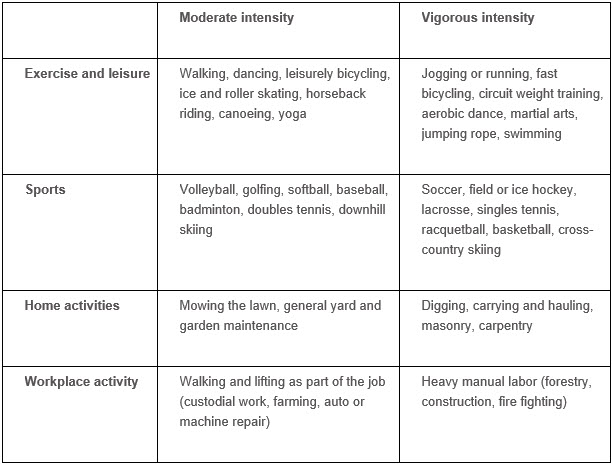
Okay, more information is good. But still…what is moderate? What is vigorous? They also had this chart to help figure that out:

According to this chart, running is vigorous. Hmmm…

Running slow and easy doesn’t seem vigorous to me. I decided to consider it moderate and see how I did. I found another article from the American College of Sports Medicine – Exercise During Cancer Treatment that gave more specifics about what to watch out for:

Individuals undergoing cancer treatment should:
•Obtain approval from their oncologist (cancer doctor) before starting an exercise program.
•Have vital signs (temperature, pulse/heart rate, blood pressure, respiration rate) monitored regularly. If participating in moderate-to-vigorous exercise, have their blood pressure and heart rate monitored before, during and after exercise to ensure that participation in exercise is appropriate and safe.
•Exercise with a partner, caregiver or exercise professional for safety reasons.
•Avoid public fitness facilities and activities (e.g., swimming), where there may be an increased risk of exposure to viral and/or bacterial infection.
•Avoid swimming if undergoing radiation therapy treatments or if they have an indwelling catheter (a tube that goes in the body), such as a central venous catheter or peripherally inserted central catheter.
•Stop exercise and contact their doctor if they have any of the following symptoms during exercise or after an exercise session:
– Disorientation, dizziness, blurred vision or fainting
– Sudden onset of nausea, vomiting
– Unusual or sudden shortness of breath
– Irregular heart beat, palpitations, chest pain
– Leg/calf pain, bone pain, unusual joint pain or pain not caused by injury
– Muscle cramps or sudden onset of muscular weakness or fatigue

And also from that page, this section on when to take precautions:

•Anemia (low red blood cell count): If the red blood cell count is low, the body’s ability to carry oxygen to the tissues is reduced. Exercise may need to be scaled back and possibly avoided.
•Neutropenia (low white blood cell count): If the white blood cell count is low, the body’s ability to fight infection is reduced. Exercise should be avoided if there is a fever above 100.4°F (>38°C).
•Thrombocytopenia (low platelet count): If platelet count is low, there is an increased risk of bruising and bleeding. Avoid contact sports or activities with high risk of injury or falling. Report any unusual bruising or symptoms, such as nose bleeds, to a doctor.
•Side effects such as vomiting and diarrhea, and symptoms such as swollen ankles, unexplained weight loss/gain, or shortness of breath with low levels of exertion may make exercise unsafe. Check with a doctor before exercising.

Ok, great. I could all that. I now felt like I had enough to go on. I decided that 2 5K runs during the weekday would be good and I’d let myself do a longer trail run on the weekends. While the combination might be more time than I’d been allotted per the guidelines, I hoped the combination of “moderate” 5K runs and more vigorous trail runs would be okay. I would just listen to my body day to day and do what I felt I could. But I have to tell you, I sometimes wanted to do more!

This was the plan through mid-January and it went pretty well. I wasn’t pushing myself too much and really just having fun. I was tired but not overly so, though I sometimes felt the same kind of tired after a 5K run that I used to feel after a 20 miler which was frustrating. I ran when I could and rested when I felt I needed it. Mostly, the pattern went like this:

  • The day after chemo I could run and feel tired but okay.
  • Then chemo would hit me and I would take the next 4 or 5 days off from.
  • Then on the 6th or 7th day after chemo, I would feel I could run again.
  • Then I would resume the schedule I set above.

But in mid-January, I got the racing bug and started thinking about my plans for 2014. What if I did more? What if I added pilates or yoga or weight training? What if I ran a little faster sometimes? What if…

***

Click Here to read Running with Cancer – PART 3: One Day at a Time  

And don’t forget, if you missed Part 1, you can read it here:

Running With Cancer – Part 1

If you’ve been through cancer and chemotherapy and are a runner, I would love to hear how it went for you. Please let me know in the comments or email me at the link below.

Posted in RunningComments (0)

Thanksgiving

Running With Cancer – Part 1

RIF #5 Lisa Gonzales

Note: I am going to be doing a series on my bout with ovarian cancer and how my running was affected by it and helped me deal with it.

2013 was supposed to be a big year for me. I had big plans – streak through at least October to complete a 1 year running streak, run 3000 miles, and lower my marathon PR to sub 4…and hopefully qualify for Boston. 2013 was going to be stellar!

Or so I thought. Things didn’t go exactly as I’d planned. Life is funny that way.

2013 started off okay. I wasn’t getting where I wanted to be  though so I hired a coach and that helped. But I was tired most of the time. I felt like I was overtrained even though I wasn’t really doing that much. I was frustrated. I kept telling my friends I was tired and nauseous and that something didn’t feel right but it never felt serious enough to go to the doctor.

Then in July, I found a bump in my abdomen. It felt about the size of a lemon and I went to have it checked out. By the time I had an ultrasound and then an MRI, it had grown to the size of basketball! I had surgery on September 30, 2013 to remove it and that’s when I found out I had Ovarian Cancer.

The C Word.

Damn.

However, I was one of the lucky ones. Every year, about 22,240 women are diagnosed with Ovarian Cancer and 14,400 women die from it. There is a 93% 5 year survival rate if it is caught in the early stages but only 15% of the women are caught this early. I am one of the 15%. My cancer was Stage 1C. I was very lucky.

I haven’t always felt lucky. I have had the “why me?” thoughts. I’ve been resigned and numb. I’ve been scared and sad. And I’ve been angry. So very angry. Angry because my life changed in one instant. Angry because I’d been doing everything right – eating right, exercising, taking care of myself – and I was still caught in cancer’s vicious web.

One reason I was angry at cancer was that it took running away from me. Everyone said that my health was the most important part and that I could/would run again. But here’s the thing. Running is the way I deal with emotions and stress. At the one time in my life when I needed it most, I couldn’t run. First because my doctor was afraid the cyst would burst and then because of the surgery to remove it. For 10 long weeks I couldn’t run. I had no outlet for all the things I was feeling. I couldn’t do anything but go for short walks and sit on my backside.

I felt trapped.

And of course, running not only helps me wash away the sucky parts of life but it is just plain fun! There’s nothing I love more than running trails and exploring new places and meeting new people. Running is how I celebrate life! I had to give up 3 marathons and a half marathon I’d signed up for. Because of cancer I missed out on the opportunity to explore Utah and Tennesse and to have fun on Halloween. I missed seeing my friends from around the country at those races. It took so much from me. Did it have to take the fun too?

No, running isn’t everything but at a time in my life when I was scared and angry, it would have been nice to have the joy running and breathing in fresh air. I especially missed being out on the trails. Oh, how I missed the trails.

My surgeon released me to run on November 26th and I may or may not have done a happy dance. His advice to me was to do what I was comfortable with. I had already talked to my oncologist about running and she encouraged me to run through chemotherapy. I decided I would start running again on Thanksgiving. It seemed like the proper day to restart running. I had a lot to be thankful for but I was most thankful I could finally lace up my running shoes again.

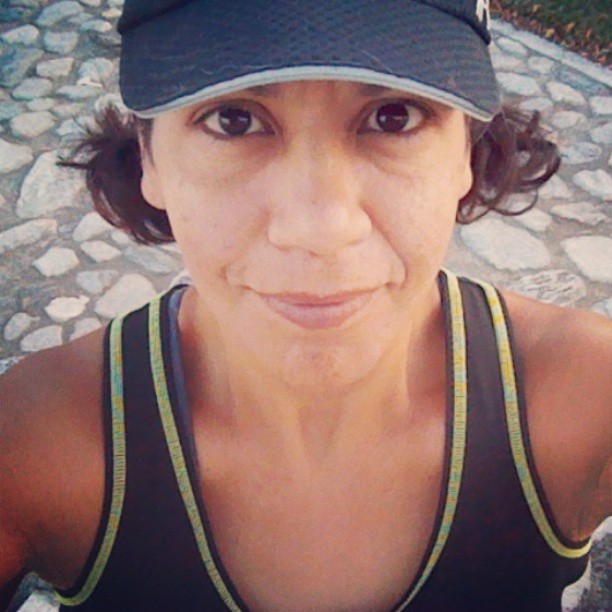
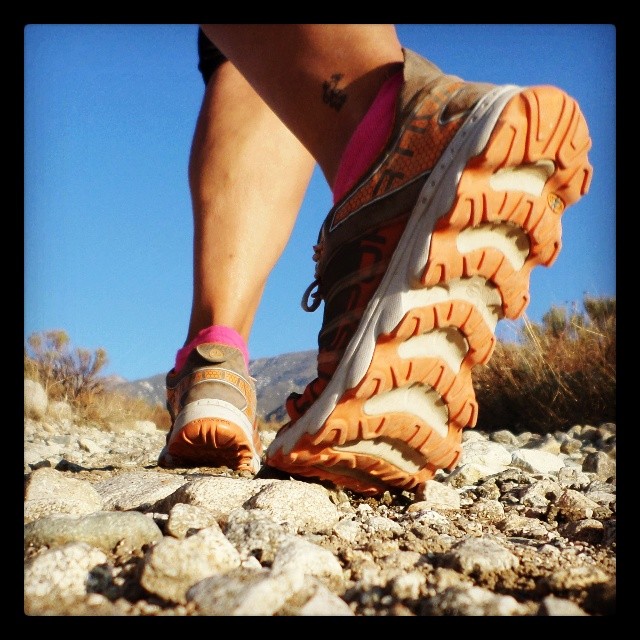
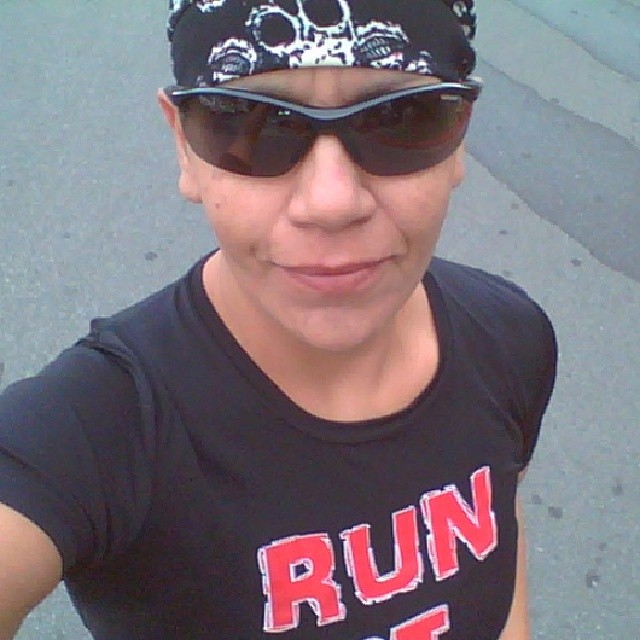
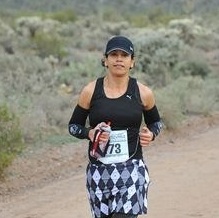
I didn’t do much that first run. I’d told myself I would take it easy and run walk for a mile or two depending on how it went. Well…I might have been a LITTLE bit excited and ended up running the whole first mile. Oops! But I did smarten up and run/walk the mile home. The pic above is from that run. Was it easy? No. Did things hurt? Yes. Mostly I was surprised at how tired I was. And maybe a little sad at how slow I was. But I was happy too.

I felt free again!

Just one run and already I felt lighter. And I felt relief. I felt like I was me again. It felt so good to be outside and moving and breathing fresh air. It was wonderful.

But oh, I had so much work to do. I was basically starting over. I’d only been out from running for 10 weeks but most of August and September was just 1 day streak savers (because I’m stubborn and hoped I could finish the year!). I had a long way to go to get back to where I was when I set my PRs. In some ways starting over is easier than starting from scratch because you know what to do. You’ve done it before. You can do it again.

In some ways, it’s harder though. Because I remember what it was like to run 20 milers. I remember what it was like to run sub 8 minute miles (fast for me). I remember how much fun marathons and half marathons and a so hard you want to puke 5K are. I’m impatient to be that runner again. I want to feel that strong and fast right now.

But I am ready to do the work. Bring it on!

The big problem is…what does that work look like? How do athletes with cancers train? Should they train while battling cancer? That is the 24 bazillion dollar question…

Running With Cancer Part 2: The Moderate Runner

Posted in RunningComments (2)

Galen Rupp Sets New American 2-Mile Indoor Record

Galen Rupp has had a good month. This past weekend he set the USA 2-mile indoor record with a time of 8:07.41. He broke Bernard Lagat’s record of 8:09.49 set last year.  Rupp had held the record prior to Lagat with a time of 8:09:.72

Earlier this month on January 16th, Rupp broke the American 5000m record with a time of 13:01.26.

More Details on Rupp’s Historic 2-Mile Record at Runner’s World

Posted in RunningComments (0)

North Korea Flag

North Korea Marathon Now Open to Americans If…

Well you have run a marathon in every state and on every continent. And now you can run a marathon in North Korea. There is only the slightest catch as you will find out below.

North Korea has opened up the Pyongyang Marathon to recreational runners, including Americans, for the very first time. That’s right, now you can run a marathon in North Korea if you finish it in 3 hours or less. If you are still running after three hours you will be shot forced to quit (unless you traveled into the country with Dennis Rodman. He will then sing you Happy Birthday and call on special favors from North Korea’s Supreme Leader Kim Jong-un…and you will still be forced to stop at 3 hours).

North Korea’s human rights record has been described as one of the world’s worst by the U.S. State Department, which recommends against all travel by American citizens to North Korea.

North Korea has detained at least seven Americans since 2009, including Kenneth Bae, 45, who was arrested in November 2012 while leading a tour group. He was accused of crimes against the state and sentenced to 15 years of hard labor. He was moved to a hospital last summer in poor health.

As noted in the article, the 3 hour cutoff is faster than every qualifying time for the prestigious Boston Marathon.  A rough estimate of 0.000005% of Marathon Maniacs would be able to finish the Pyongyang Marathon in less than 3 hours.

You’d probably be better off signing up for the cheaper, more scenic, and challenging Cummins Falls Marathon on February 22, 2014.

Posted in International, Marathon, RunningComments (0)

Chris Solarz

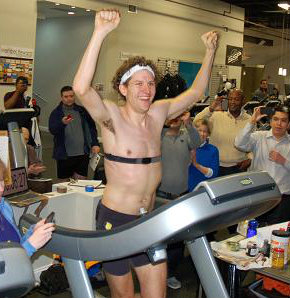
Chris Solarz Sets 12 Hour Treadmill Record with 77.07 Miles

Hedge fund manager Chris Solarz ran 77.07 miles in 12 hours on a treadmill to set a new record with the Guinness Book of World Records.

“This was the most physically demanding of all of my six Guinness records,” Solarz said. “I knew that the record was just within my reach but I would need to get in the best shape of my life. After I put in 150 mile weeks for two months, I knew I could do it, but I still needed to execute. I had a perfect day and ended up breaking the record less than seven minutes before the 12 hour mark!”

He beat the prior record of 76.68 miles set in 2013 by Eusébio Bochons in Switzerland. Solarz did not leave the treadmill for the entire 12 hour period and ran at an average pace of 9 minutes and 20 seconds a mile.

Solarz owns a handful of other Guinness World Records.

Read More about the new 12 Hour Treadmill World Record

Posted in RunningComments (0)

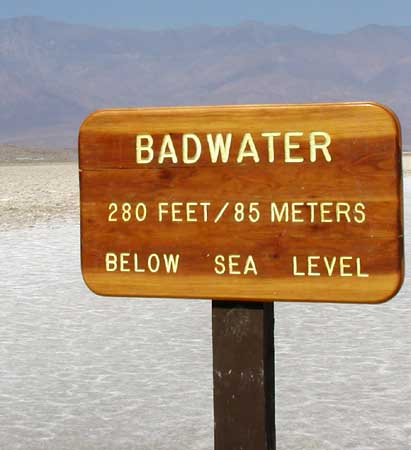
Badwater Race Director: Death Valley National Park “Grossly Exaggerating the Safety Issue…Smearing Reputation of Badwater 135”

Badwater Race Director: Death Valley National Park “Grossly Exaggerating the Safety Issue…Smearing Reputation of Badwater 135”

AdventureCORPS Chief Adventure Officer (CAO) and Badwater 135 race director Chris Kostman sent a very detailed email to Run It Fast® this morning.

In it, he responds to the ban by Death Valley National Park on Badwater 135 and all endurance related races within the park that require a permit. He believes, “..the DVNP staff are grossly exaggerating the safety issue, and, in so doing, they are smearing the reputation of the Badwater 135 and other events, perhaps to build a case for severely restricting, if not banning, some or all events from being held in the Park.”

You might remember back in December, the park ceased issuing permits for endurance races with little to no explanation as to why. It led us to speculate as to those reasons due to the extreme lack of transparency from DVNP (Read HERE).

Death Valley National Park superintendent Kathy Billings responded to our post with a long winded letter that stated that her decision to suspend events within the park was so that a ‘safety assessment’ could be conducted (Read HERE). Billings in her letter claimed that, “multiple near misses between event participants and park visitors were observed.”

As you can read below, Kostman adamantly doesn’t buy the parks stated reason/excuse claiming that DVNP’s decision was due to safety concerns. Kostman clearly details that Badwater 135, in 26 years, has never had a participant hit or injured by a car and that no accidents have taken place within the park during any of his races. Safety to Kostman and AdventureCORPS has always been a priority.  He then goes on to state that the random deaths that have happened within the park, happened outside of any race, and involved tourists and a park ranger but never an athlete in an event.

Kostman details how AdventureCORPS has always put safety first in hosting their events and that they hold themselves to a much higher standard than DVNP or anyone else ever could. Safety has always been a priority to them and that AdventureCORPS flawless record to date affirms that.

Read Kostman’s email to Run It Fast regarding Death Valley National Park’s ‘Safety Claims’ below in it’s entirety:

The Death Valley National Park staff can “play the safety card” all they want, but they are not the only people concerned with the safety of the event, in fact, far from it. As the organizers of the Badwater 135 and four other events normally held annually within DVNP, we are particularly and necessarily concerned with the safety of both event participants and the public at large. Additionally, a meeting with DVNP staff in December included representatives of both Inyo County and the California Highway Patrol who spoke on behalf of the safety record of the events and lobbied for the events to be held in 2014 and beyond. In our opinion, the DVNP staff are grossly exaggerating the safety issue, and, in so doing, they are smearing the reputation of the Badwater 135 and other events, perhaps to build a case for severely restricting, if not banning, some or all events from being held in the Park.

The DVNP staff can claim “near misses” on the highway between cars and pedestrians all they want, but where is the proof? The facts of the matter are simple and irrefutable: In the 26 history of the Badwater 135 Ultramarathon, not one event participant, supporter, or bystander has ever been struck by a car, nor have there been any car crashes other than one family member – not an active crew member – who simply drove off the road in 2012, perhaps because of a medical condition. Not one event participant, supporter, or bystander has been evacuated by ambulance. Not one event participant, supporter, or bystander has been issued a citation by DVNP Rangers, California Highway Patrol, or Inyo County Sheriff’s deputies in association with the event. DVNP statements to the press about “mass casualties” and “dead bodies” would seem to incite fear and overstate dangers. After all, in 2014, who can question anything about “safety”?

Meanwhile, three to four people die within Death Valley National Park every year, most recently an NPS employee who was working alone on the little-used and unpaved Westside Road during a heat wave with, according to those in the know, no functional radio and only minimal supplies. He died a tragic death of heat stroke after walking 4.6 miles, in vain, in search of help.

There have been no deaths associated with any sports event held within the Park, ever. (Contrarily, there have been deaths during sporting events in other Parks, but said events were not stopped.)

Special Event Permits have been issued to our organization 89 times over the past 24 years by Death Valley National Park without incident and without refusal, until now. Similarly, nearly all of the events also require permits from the California Department of Transportation, Inyo County, and/or United States Forest Service. Presumably all those government agencies are similarly concerned about any safety impacts that the events may present, yet none of those agencies has refused to issue permits or placed a “moratorium” on issuing permits. None of those agencies is casting aspersions on the reputations of the events, nor denying the opportunity for athletes to come from all over the world to enjoy this Park and pump money into the Park and the local economy.

In our December meeting with DVNP staff, we presented an eight-page proposal to further enhance the safety of the Badwater 135, a plan that clearly answers every issue brought up DVNP in their assessment of the July, 2013 event. While pointing out the impeccable safety record of the event, we explained that we are our own biggest critics and we hold our events up to the highest standards. We proposed effective, reasonable mitigation measures which will further enhance the event’s safety record and we requested the opportunity to demonstrate the effectiveness of these efforts during the July, 2014 edition of the event. We were refused, with no rationale given whatsoever. In fact, in all our correspondence and communication with the DVNP staff, and in everything we have read online and in the press, we have seen absolutely no rational explanation offered for the unprecedented decision to ban the events in 2014 while this “safety review” unfolds. It begs the question: How does one review the safety of something which isn’t even happening?

One further wonders what purpose it serves, and how public safety is enhanced, to effectively ban the event when the event will still be held in the very same county, on some of the very same roads, except outside DVNP jurisdiction? There will be no net change in overall event safety, nor public safety, by simply moving the event outside Park borders.

During the December meeting with DVNP, it was pointed out that the Park’s disallowing of the Badwater 135 in the summer of 2014 will simply cause dozens, perhaps scores, perhaps hundreds, of runners and their support crews to simply run the traditional route from Badwater in Death Valley to Mt. Whitney on their own, outside of an actual event. “It’s a free country,” after all, and the roads are open to the public, yet those types of “solo” runners will not be vetted for their worthiness to attempt such a feat, they will not be monitored by race officials and controlled by race rules and the possibility of time penalties or disqualification, they will not have a 15-person medical team with an ambulance on standby in case of emergency, they will not have any rules or guidelines limiting the number of support crew members and the number, size, and type of support vehicles.

In response to explaining how the “law of unintended consequences” would have the effect of unleashing these unregulated runners onto the roads within the Park, the Chief Ranger for DVNP stated “We are not their parent.” All of the DVNP staff in attendance showed no concern whatsoever for the potential for their staffing and resources being stretched thin while runners challenge the Badwater 135 race course all summer long with no oversight. They showed no concern for the potential for all these unsanctioned runners to impact public safety, even though they claimed that public safety was their primary concern in undertaking their “safety review” and banning the events in the interim.

In regards to cycling events, during the December meeting, DVNP staff, the Park Superintendent in particular, complained about the difficulty of passing bicyclists on the roadway, without changing lanes, during those occasional stretches of DVNP roadways that have double yellow stripes down the center of the road. This is the exact same type of complaint leveled at bicycle users by anti-bike and anti-pedestrian motorists all over America, with the implication being, quite falsely, that roads are intended for motor vehicles, that motorists have superior rights to use of the roads, that motorists have a right to never be inconvenienced nor forced to slow down. While this type of anti-bike bias is still all too common in America, the tide has turned in city after city, county after county, state after state, as government agencies realize that bicycling plays an important, crucial role in the wars on obesity, traffic jams, and pollution. Increasing the roadshare by bicyclists has become a priority for government agencies across America, including the National Park Service, which promotes bicycling as a way to enjoy and travel through Parks.

As for DVNP denying that events are not being “banned” in 2014, and that our statement to that effect is “erroneous” they are playing semantics. The fact of the matter is, one marathon will be held on February 1, but only because the organizers already had their permit in place before the ban went into effect. Other than that, the ban means that the following events will not take place during the “safety review” period, nor for many months afterward:

Feb 24-27
CORPScamp Death Valley
A five-day cycling camp based in Furnace Creek with about 50 participants who typically come from 12-15 states and several foreign countries. It has been held since 2008 without incident and was not “reviewed,” per se, during any recent edition, thus its potential impact, if any, has not be assessed.

March 1
Death Valley Century, Ultra Century, and Double Century – Spring edition
A one-day 100-mile, 150-mile, and 200-mile bicycle ride with about 300 participants who typically come from 15-20 states and several foreign countries. It has been held twice a year since 1990 without incident. Its sister event, a Fall edition held on the last weekend of October, was reviewed by two DVNP staff members: Safety Officer Peter Treuherz and Law Enforcement Ranger Jordan Mammil. Treuherz’s report has not been seen, but he was overwhelmingly favorable about the event in conversation that day, with only a few small constructive suggestions to make. Mammil’s report is entirely favorable towards the events. She stated, among other things, the following:

“In my opinion, the Century Bicycle Ride is a highly organized event drawing a diverse set of visitors.  These visitors are able to enjoy the park in a very unique manner.  The event essentially has no impact on the park, the visitors, or any of its resources.  It is a nice way to bring revenue to adjacent businesses, and attract cyclist and their supporters to the area.”

“It appears that the event does not need monitoring.  There is very little chance of disturbance to other visitors, and this event leaves very little, if any impact.  The participants are other outdoor enthusiasts, sharing the joy of seeing a large section of the park with essentially no carbon footprint.  In my mind, the park should do whatever it can to encourage and support such events.”

In late December, we received a letter from Park Superintendent Billings detailing a few minor criticisms or observations of this cycling event, and the tone and content of her letter was entirely negative. Granted, any event can be made safer, and a few “bad apples” will occasionally disregard event rules, but the event has an unblemished record and was enthusiastically endorsed by a law enforcement professional with many years of experience working on the open roads of multiple National Parks. Yet no mention of Ranger Mammil’s positive report regarding the event was made. No opportunity to host the March 1 edition was offered.

July 21-13
Badwater 135 Ultramarathon
Drawing up to 100 runners and their support crews from 20 or more countries and 20 or more American states, along with race support staff and the media and eyes of the world, this iconic event will take place on a Lone Pine, CA-based route just outside of DVNP boundaries. Still named “Badwater 135,” it will not begin at its namesake, Badwater, because of the DVNP ban on events in 2014. http://www.badwater.com/route/

October and Beyond:
DVNP finally posted their statement about the 2014 ban on their website on Christmas eve, 2013. In it, they stated, in part:

The safety assessment process is expected to be completed by Summer, 2014. The safety assessment report will include safety mitigations, specific park approval criteria and condition recommendations for sporting events within Death Valley National Park.

Based on the projected date for completion of the safety assessment, applications may be submitted for events that are scheduled from October 1, 2014 and beyond. The park will begin processing those applications when the safety review is completed. Findings from the risk assessment may require new conditions that will be required of all event coordinators to meet permit requirements and/or that some events may not be allowed in certain areas or permitted in the future if safety risks cannot be mitigated to an acceptable level.

Also:
Due to the complexity of the process, it can take several months to process a special use application and applicants are encourage to get their requests in early.

A quick read of the DVNP statement would suggest that it will be possible for special events to take place in October, 2014, but that is effectively impossible. This is because they have not set a firm deadline for completing their “safety review” and finalizing their new guidelines. They only state “by Summer, 2014,” however Summer does not end until September 23. They also stated, during the December meeting, to not expect resolution until the end of their fiscal year, which ends on September 30.

Their online statement also states that, though permit applications may be submitted at any time, they will not review them until their internal process is complete. As such, there is little logic in applying to host special events until all the details, new regulations, and new restrictions are known. Additionally, a full field of athletes, a full event staff and cadre of volunteers, and all the operational details that are needed to host and produce an event do not just fall out of the clear blue sky; they take time, usually 6 to 12 months on average, to pull together. Therefore, the inference by DVNP that sporting events could take place in October of this year is erroneous and misleading at best. This ban therefore impacts multiple events which might have been held in October, but which are also effectively banned by DVNP this year:

The Whitney Classic charity ride from Badwater to Mt. Whitney, held annually since the 1980s, will not be able to take place on its traditional last weekend of September. (Not an AdventureCORPS event.) http://www.summitadventure.com/whitney-classic/

Furnace Creek 508, a 508-mile cycling event held annually on the first weekend of October which has passed through DVNP since 1989, will have to be moved in its entirety to another state, rather than held this year on its traditional route. It averages 250 cyclists, riding solo or on two- or four-person relay teams, who come from all over the world to compete in what is known as “the toughest 48 hours in sport.” http://www.the508.com

The Ride to Cure Diabetes, held by and on behalf of Juvenile Diabetes Research Foundation, raising over one million dollars annually for this cause, will not likely be held on its traditional date on the third weekend of October. (Not an AdventureCORPS event.) http://www2.jdrf.org/site/TR/Ride/JDRFNationalRides?pg=entry&fr_id=2246

The Fall edition of the Death Valley Century, Ultra Century, and Double Century will not be held on its traditional date on the last weekend of October.

I’m not clear how, or if, the 49ers Encampment, traditionally held in early November, will be impacted by the DVNP ban, but it must have implications for their event as well. Their event is not a sports event, but its size and scope, which far exceeds that of any of the sporting events, certainly have some impact on traffic and Park safety.

I will conclude by pointing out that DVNP spokesperson, Cheryl Chipman, has stated (perhaps “complained” is more accurate) that “the park doesn’t directly make money on such events, with permits costing $210 each. She said organizers cover the cost of a park employee required to monitor events,” according to the LA Times:http://www.latimes.com/travel/deals/la-trb-death-valley-badwater-race-permits-20131226,0,156333.story#ixzz2pkNbxFwR

This statement deliberately ignores many facts and positive economic impacts which the Badwater 135, and other events, bring to Death Valley National Park, including:

– The entire Stovepipe Wells Resort, including the motel, restaurant, bar, two stores, and gas station, are owned by the National Park Service and these events bring a tremendous amount of money to the location, which is at mile 42 of the Badwater 135 route. The general manager, David MacIlwraith, has stated “race day is one of our largest revenue days for the year for the General Store.”

– Event participants, staff, support crews, family, and friends all spend money in the gift shops operated by Death Valley Natural History Association, an organization which is based in and directly support the Park, its mission, and its operations.

– Many event participants support the Death Valley Natural History Association. In fact, AdventureCORPS has raised or donated over $19,000 to DVNHA in recent years and there are five plaques in the Death Valley National Park Visitors Center which acknowledge AdventureCORPS / Badwater 135 / Furnace Creek 508 support.

– One hundred percent of Park Entry Fees are paid by or on behalf of every participant in evert event. Meanwhile, traditional Park visitors are expected to voluntarily pay the Park entrance fee at a self-serve kiosk or by stopping in the Visitors Center. There are no toll booths on the highways or at Park borders as at Yosemite, Glacier, and other National Parks, because DVNP does not actually control Highway 190, the thoroughfare which passes through the Park. Thus, sport event participants all pay their way, while many other Park visitors ignore the entrance fee requirement.

– Participants in Death Valley sporting events become tireless Park Advocates because of their intimate experience of, and appreciation for, this dramatic landscape and American treasure. They tell their friends about the Park, post widely on the Internet about their experience, support the Death Valley Natural History Association, and become regular visitors. In a time of dwindling government funding for the National Park Service, our athletes are exactly the kind of people that the NPS desperately needs spending money within the Parks and extolling their critical importance to their neighbors and their House Representatives, Senators, and other government officials. Why slam the door on the best people the Parks have in their court?

All told, the impact of this 2014 Death Valley National Park ban on sporting events is absolutely massive, with reverberations across the globe, but especially within the Park itself and the gateway communities which depend on tourism dollars. The ban is also unprecedented and unnecessary, hurting the Park far more than it is helping it.

Yours in sport,
Chris Kostman,
Chief Adventure Officer and Race Director
AdventureCORPS, Inc.

So there you have it! Kostman does a strong job of clearly stating that AdventureCORPS has always put a priority on safety. He goes into detail about races within the park and what they bring to the community in terms of revenue and tourism.

RELATED – Death Valley National Park – Badwater Stories on Run It Fast:

We are hoping that DVNP will quickly reverse it’s decision and once again start granting permits to Badwater 135 and all the rest of the great running and cycling events that happen every year in the park.

Badwater 135 is an international event that brings the best athletes in the world to Death Valley National Park and the best out of the human spirit in those that come to run, crew, cheer, and witness what the human body can accomplish within the beautiful landscape of DVNP.  The park and race officials had enjoyed a great working relationship for three decades before Billings came into power this past year.

We hope common sense will win out with Billings, that all of the races in DVNP will once again resume, and that DVNP and race directors alike can work TOGETHER to ensure safety for all involved in these great events that bring lots of attention and revenue to the area.


Posted in Badwater 135, Running, Ultra MarathonComments (0)

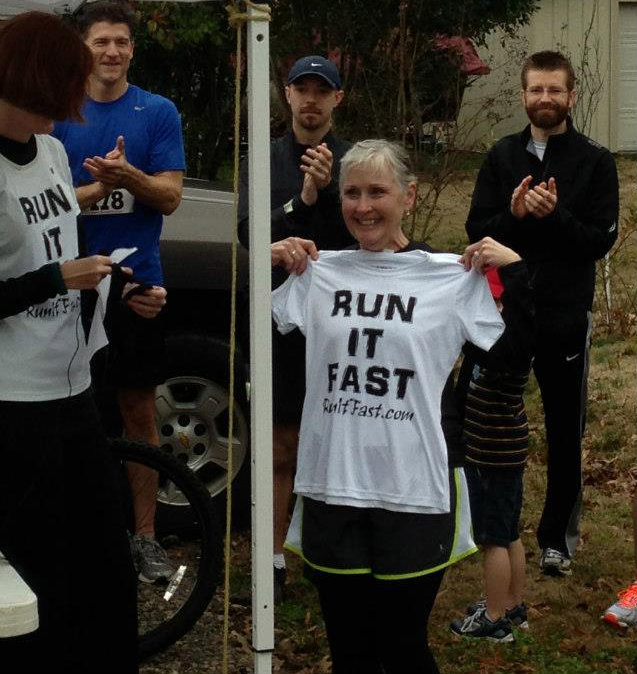
Hope Shull with Marj Mitchell Race for Hope

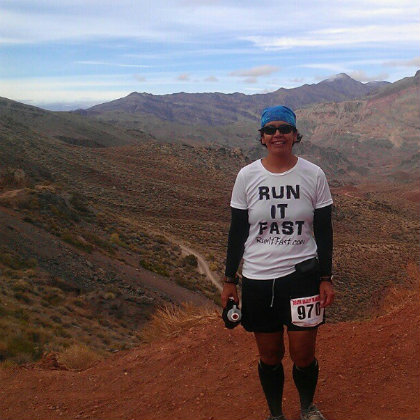
Lisa Gonzales is the 2013 Hope Award Winner

Last January, we presented Hope Shull with a membership to Run It Fast – The Club at the Race for Hope 5K in Henderson, Tennessee.

The 5K was held to honor Hope as she had terminal cancer with just a few weeks to live. She died shortly after the race was held.

Hope was a personal friend to myself and many other of the early members of Run It Fast. I ran several of my very first 5K races with Hope and her good friend Marj Mitchell in West Tennessee.

I wrote Hope a letter to be presented to her at the Race for Hope 5K last January that Marj read to her at the race.  The letter included a permanent membership to Run It Fast along with a few other words that included the creation of an award in her honor –  ‘The Hope Award.’

January 12, 2012

Hope,

I’m amiss that I can’t be at the race today.  I’m in Los Angeles, but you are on my mind as you often are.

I asked Marj if it would be ok ,and she thought it would be, so I want to proudly announce you as the newest member of Run It Fast – The Club.

You will always be RIF #225, a special number to me as 25 has always been one of my two most favorite numbers.  You will always be a part of the club no matter what transpires from this day forward between any of us.

I’ve always wanted you to be a part of the club because you embody EVERYTHING that Run It Fast was created to become. Run It Fast is a club full of members that have this deep down desire to overcome obstacles in life and limitations that most others let hold them back or down. Run It Fast members don’t let their situation or hardship in life dictate their life for them.

Instead they go out and conquer life by digging deep to train hard, run races, and forge friendships along the way that inspire others to do things that perhaps they didn’t think were possible either.

Also, I want to announce that starting this year, at the end of the year, the Run It Fast – Club will annually give one member the honor of being named the Hope Shull Inspirational Runner of the Year!

I want to thank you from the bottom of my heart for the example you’ve set for me not only with running but with life.  I’ll never forget sharing the car ride back to the start of the Labor Day 5 Miler with you a couple of years ago. That was a beautiful day and a lot of fun.

With my utmost love, respect and admiration, 

Joshua Holmes

Run It Fast ® (RIF #1)

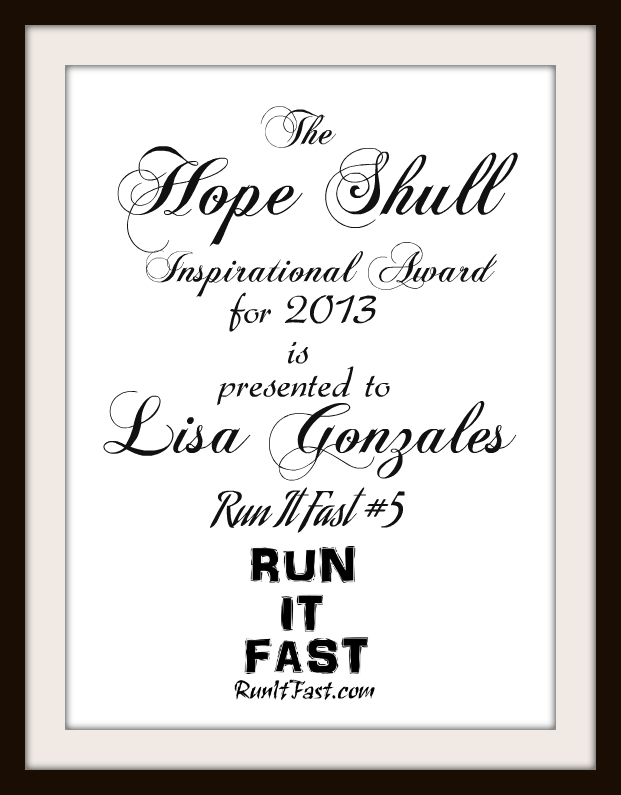
I’m proud and honored to announce that the ‘2013 Hope Shull Inspirational Runner Award’ goes to RIF #5 Lisa Gonzales from Alta Loma, California.

Lisa has inspired all of us with her bravery, courage, and tough inner fortitude in battling cancer over the last few months while never losing faith and being extremely positive and supportive of every member of Run It Fast, as she recovered from surgery and continues to go through chemotherapy.

Lisa insisted upon crewing me at the EC 100 just two weeks after her surgery. She has yet to deliver me a good cheeseburger during a 100 miler when crewing me, but she did a great job that day crewing me to a Top 5 finish.

She has been vital to the growth of Run It Fast over the last two years and has a true passion and desire for the club to become the best.

She is one of the toughest people I know. I draw inspiration from her, not only during my races, but in life in general. My worst days are nowhere near what she has gone through and survived in the past year.

Lisa gives ‘Hope’ to hundreds of runners in the running community across the globe every day!

I’m very proud of Lisa and honored that she is the 2013 recipient of ‘The Hope Shull Inspirational Runner Award.’

Posted in Running, THE CLUBComments (0)

Runner Resolutions for 2014 from Twitter

Runner Resolutions for 2014 from Twitter

We asked on Twitter for some of your running resolutions and goals for 2014, and you responded with these New Year Resolutions.

Thanks to all who took time to respond and good luck in 2014!

Posted in RunningComments (0)


Run It Fast on Twitter

twitter button free

Archives