Pikes Peak Marathon Race Report (2006) – Trent Rosenbloom
Pikes Peak or Bust –
The Pikes Peak Marathon is in a class of its own, distinguished by Pikes Peak itself, one of Colorado’s most notorious 14ers. Among the 53 or 54 mountains in Colorado higher than 14 000 feet at the summit, Pikes Peak carries a reputation for challenge and a history of intimidation. Pikes Peak derives its fame and reputation from being easily visible for many miles to the east, more so than any other of the Colorado Rocky Mountains. It has long been the single goal for homesteaders and then miners headed westward. For these early westerners, Pikes Peak was once thought to be unconquerable due to its elevation, conditions and location. While it is now clear that the Peak can be readily summited by car, foot or rail, the Barr Trail up its eastern face remains among the most challenging footpaths around.
From town, the round trip up the Barr Trail to the Pikes Peak summit is just shy of twenty-six miles. It would seem logical to create a marathon that covers the up and down route, right? Well, the Pikes Peak Marathon is not your usual marathon. It is not a road race since most is on trail, and it is not a typical trail marathon because it starts and finishes on road, has a large field with plentiful aid stations along the course, and takes most participants far longer to complete than other marathons. Furthermore, because of the big mountain that occupies most of the course. For most, the Pikes Peak marathon is actually two events: it is first a long 13.1 mile fast run/hike over an average 11% grade path that includes a road, a narrow trail and numerous switchbacks and rocky step-ups to a point well above treeline; second is a tough as nails, body-beating downhill half marathon on the same course, with a clock timing the whole thing as a single event. As you climb from below 7000 feet elevation to above 14 000 feet, the air thins, your thinking muddles, your legs tire and your mind despairs. But time flies and before you know it, you are headed back downhill. Most runners cannot actually run the whole way up. Yet a few feet from the turnaround point, you feel the air return and your thoughts clear. This occurs just in time to feel the burning in your quads and back. Pace is vital; run ahead of your abilities and predicted time and you will risk burning out. Run too slow and you will risk spending too long under the dangerous conditions on the mountain. The average finish time for the past five years is 7:06 for men and 7:36 for women. Last year’s winner finished in 3:58. These are very long times for a run at marathon distance, speaking to the difficulty of this course.
This past March I signed up to run this marathon, which was a strange thing for me to do. I never really saw my self as a runner or an endurance athlete, and until recently I never put in consistent miles. I had grown up an introverted and asthmatic kid and participated in very little physical activity, instead preferring schoolwork, camping and computers. The madness leading up to my registration actually began about thirteen years ago. I remember a friend taking me to a running store to buy my first pair of running shoes. After that, the two of us would periodically run and walk/run a three mile loop near my home. My friend was always stronger and faster than I, but he patiently helped me along and to build a small base. At that time, I was in school and the running helped both to clear my mind and to challenge me. But I never ran seriously, competitively or regularly. Over time and with effort I improved, and eventually I was able to complete the three-mile loop near my home without stopping. I had many other interests and activities in my life, however, and for many years I ran only sporadically and never more than three miles. I remember back six and a half years ago when I realized that I wanted to attempt to run a marathon. I had watched folks on television running the inaugural Country Music Marathon in Nashville, TN, and figured that if they can do it, so could I. Some time later, I actually started to train. But I had no idea what I was doing, did not really take the training program I had downloaded off the web very seriously and did not properly build up my miles. I ran the second annual Country Music Marathon, bonked at mile 12, and then did not run again for three and a half years.
Things changed a little over a year and a half ago when I was inspired anew to run. My older daughter had been running cross-country in grade school and I realized that I missed the sport. Shortly thereafter I learned that I was going to be near Duluth, MN over the weekend of the 2005 Grandma’s Marathon. From friends, I had heard great things about Grandma’s Marathon: it runs along a beautiful and flat route along the shores of Lake Superior during the cool of the Minnesota early Summer. To run Grandma’s, I had only 7 1/2 months to build my mileage base back up from nothing. That very evening I tied on my old running shoes, ran a mile and didn’t collapse from the effort. The next day I ran two. Then three. Within a month, I was actually up to about 20 miles per week. With this base established, I started training regularly the following January. I first trained with a local running club, the Nashville Striders, for the 2005 Country Music Marathon. Country Music Marathon was scheduled to occur seven weeks before Grandma’s that year. My goal in training for the Country Music Marathon was to benefit from the local training program, and to allow myself a seven-week window to recover should I become injured or sick during training. By good fortune I did not get injured or sick and so I ran the Country Music Marathon, and then Grandma’s Marathon 7 weeks later. My times were not special, but I was able to keep going and completed the distance. Somewhere along the way I thought it might be fun to complete five marathons in ’05. This goal was both silly and arbitrary. But what the heck? After three marathons in the Fall, I completed this goal.
I met 2006 without any significant running goals. I wanted to break 4:00, which I did easily in my first marathon of the year, and I also ran a few tough marathons in the following weeks, including really hot Country Music and Grandma’s Marathons, and a hilly, long (i.e., it was about 26.9 rather than 26.2 miles) Grandfather Mountain Marathon. Finishing the Grandfather Mountain Marathon, I had tallied up nine marathons in 14 months and ten in my life. These were fun and it is always great to go through the finish line at a marathon. But I wanted more of a challenge.
A group from Nashville had run the Pikes Peak Marathon during each of the past few years, and they always have had great stories to tell and pictures to share. Last year they went out early and ran a few races in the weeks before and had a blast. One of them in particular, Diane, is very convincing and very nice, runs a lot of marathons and ultramarathons, and when she says “c’mon”, it is really easy to follow. So this year, when registration opened and she made sure I knew it had opened, I gave Pikes Peak serious consideration. Because last year was the 50th anniversary for the Pikes Peak Marathon, interest in the run was high and the marathon was expected to fill in less than 24 hours. I knew I had to make a quick decision. I checked with my wife (who was not sure what she was getting herself into) and she said, “Whatever you want to do”. So I registered. Once registered, I knew that I had to put my shoes where my money went. From Nashville at an elevation of 500 feet above sea level, with hills that max out at about 400 feet, I somehow had to train to complete a marathon at high elevation that climbs vertically nearly one and a half miles in elevation gain over its course, then drops the same before the finish, with the whole thing taking 150%-200% of my normal marathon completion time.
When asked to name the hardest marathon in the country, many runners name Pikes Peak. The Pikes Peak Marathon carries the moniker “America’s Ultimate Challenge”. When asked about Pikes Peak, many veterans equate it to a tough ultramarathon. They make this comparison not because of the total distance, which after all is just 26.2 miles. Rather, the Pikes Peak Marathon is equated with ultramarathons because of the long time required to finish, the strategy required for completing it, the fact that it is mostly on steep rugged trail, and that it requires as much effort as many ultras. In addition to the trail conditions, the elevation and the length, Pikes Peak adds the potential for extreme weather; it could be hot and sunny, raining and slick with lightning, or even snowing and sleeting (as was the case last year). And runners may experience all of these conditions during the course of a single run. To compound the drama, people running this thing occasionally die. As in dead. I was fortunate to have had a conversation with Jack Menard, an ultramarathoner who recently completed the Badwater 135 mile Ultramarathon that starts in Death Valley and finishes at the base of Mount Whitney. Menard stated that Badwater is just a long walk in the heat, while Pikes Peak is really tough. I think he may have been exaggerating, but there is truth in every lie. Many runners jump off from running Pikes Peak into ultramarathoning because after the Peak, 26.2-mile races on flat asphalt courses just don’t compare. What was I thinking? My wife keeps telling me that she needs to buy more life insurance for me.
Living in Nashville, how was I supposed to prepare for this challenge? How could I ensure that I would complete the marathon and come away uninjured and with positive memories? How could I do as well as possible on such a tough run? Well, the first thing I did was go over to Matt Carpenter’s website, www.skyrunner.com. Carpenter lives, trains and runs at the high altitudes of Manitou Springs, the home of the Marathon. Carpenter sets records on nearly every course he runs, including the Pikes Peak Marathon. Last year he took a break from Pikes Peak to run the Leadville Trail 100 mile Ultramarathon, and crushed the record there by finishing in 80% of the time of the prior record. Carpenter knows a thing or two about running hills and distance at high elevation. From the website, his basic suggestions for those who live close to sea level and without major mountains (i.e., so called “flatlanders”) is nonetheless to emulate the Pikes Peak Marathon as much as possible. To do that, one needs to: 1) run several times for more than four or more hours; 2) run at inclines of 10-12%; 3) run as much as possible on rugged trails; and, 4) learn as much about the course as you can. Carpenter comments that for flatlanders, there is no way to emulate the effects and feelings of running at altitude short of actually running at altitude. That said, I had received other advice that any time I spent at high elevation in the days leading up to the marathon would help. Since I have a day job and could not go to Colorado for weeks or months of high altitude training, the best I could do would be to spend a single week beforehand climbing some of Colorado’s 14 000 foot mountains and sleeping at 10 000 feet above sea level. Just a week at high elevation would not suffice to permit my body fully to acclimate. However, it would allow me to begin a physiologic adjustment, and would lead to some mental acclimatization. By that I mean I would learn what low oxygen feels like and have a sense of how to deal with the chest palpitations, dizziness, nausea and headache that it brings. It was also possible that spending the time at altitude would reduce the chance I would feel those symptoms during the marathon itself.
So I did my best to follow Carpenter’s guidance. I ran a few marathons this Spring as training runs, including another tough and hilly Grandfather Mountain Marathon in Boone, NC seven weeks before Pikes Peak. I pushed my weekly miles higher than they had ever been, purposefully flirting with overtraining. I ran fairly technical 4- and 7-mile trails that include some major steep climbs and descents. And I read the Pikes Peak Marathon route description several times. I ran as often as I could in the boiling hot and humid Middle Tennessee Summer to grow accustomed to running dehydrated and under uncomfortable conditions. Then, having done all I could in Nashville, I went with our local Pikes Peak Marathon group to Colorado nine days before the marathon to run, climb mountains at high elevation and begin to adjust to the altitude. The marathon was on Sunday, so we flew out to Denver Friday a little more than a week before to begin the process.
Our plan for the week was to spend as much time sleeping, sitting, hiking and running at high elevation. Saturday, we ran the Georgetown to Idaho Springs Half Marathon. The run started at 8500 feet elevation, then dropped 1000 feet over its course, despite a few rolling ups. I ran feeling short of breath and lightheaded, with heavy spaghetti legs the whole way. All the runners in our group ran about a minute/mile slower than our usual half marathon pace. Upon completing the half marathon, we went to Leadville, Colorado to spend a couple of nights sleeping at an elevation of 10 000 feet above sea level. On Sunday we ran the Leadville Trail 10k over a course that covers the first three miles of the Leadville Trail 100 mile run, and goes down a 400-foot steady drop over the course of 3.1 miles. At the halfway point you turn around and return to the start up the same hill. Again, we all ran relatively slow, and my pace was a little more than a minute slower than my usual 10k pace, but one member of our group took 4th overall, beating out many of the runners who are well accustomed to the altitude. The next day, Monday, we climbed Colorado’s highest peak, Mount Elbert. The climb covered 4.6 miles and rose an average 23% (and a maximal 50%) grade, over trail, piled rocks and scree, with no real switchback to soften the climb. We spent an hour at the summit, over 14 300 feet, eating cold pizza and granola bars. From the summit, we RAN back down to the cars to get a feel for running down from high elevation, with a severe grade and on a questionable surface.
On Tuesday, we drove up Mount Evans to get more time at high elevation. Mount Evans is another Colorado 14er and has the highest road accessible point in the country. We drove to avoid overexerting ourselves in the week before the marathon and to allow some recovery from the efforts the days before. Just below the summit, at about 13 000 feet, there is a lake (called, surprisingly, Summit Lake) with a few nice trails around it that we hiked. Of course, our hiking was limited by the growing pain in our quads and calves from that 4 mile downhill run the day before. On Wednesday, well rested, we climbed another 14er called Mount Democrat. Mount Democrat required climbing an average 23% grade, but this was mostly over small boulders and scree through a poorly marked trail; the 2 mile climb took almost as long as the 4 mile climb up Elbert. After an hour at the summit elevation, the icy wind and menacing dark clouds convinced us to head back down. Halfway down, we decided to call it a day rather than attempt the adjacent 14ers, Mounts Lincoln and Brosse. On Thursday we drove back up to Mount Evans to spend the entire afternoon at elevation. We sat atop the summit reading and relaxing for five hours through changing weather that brought sun and 60s at one moment and sleet and snow with a cold wind at another. Elevation training done to the best of our abilities, on Friday it was off to Colorado Springs to get ready.
Marathon weekend brings two events to Pikes Peak: the Ascent, a 13.32 mile race from Manitou Springs up the Barr Trail to the summit on Saturday; and the Marathon, a 26.2 mile round trip from Manitou up to a point just below the summit, then back down to town. Approximately 20% of the runners participate in both events, accomplishing a feat known as the Double. One member of our group, the same Diane who got me out here, signed up for the Double. The rest of us tried to retain a small shred of sanity by running just the Marathon or the Ascent. Our plan was to arrive in Colorado Springs, pick up our packets, visit Garden of the Gods (an attraction comprised of beautiful red-rock boulders balanced at precarious angles, rising above a conifer forest, then grab dinner and get some sleep. The next morning, Diane was to awaken early and go to the Ascent, and we would drive up on the road that wraps around the Peak to meet her at the top. We registered and went to the small marathon expo at the center of Manitou Springs. There, we met a few other runners, including the publisher of the magazine Marathon and Beyond and, by sheer coincidence, one of the people who registered for the Harpeth Hills Flying Monkey Marathon, a new tough and hilly marathon in Nashville that I have had the pleasure of organizing. After a quick dinner and a trip to Target to stock up on some last minute gatorade and dark chocolate M&Ms, we all went to bed. The night was punctuated by numerous intense storms with powerful lightning and earth-shaking thunder. The quantity and persistence of the rain was uncommon for Colorado Springs, and threatened to make the trail conditions tough for the Ascent, washing out deep ruts and pushing boulders into the way. Diane woke up dutifully and took off on the Ascent. After a pancake breakfast, we hopped into the minivan and drove to the densely fog-enshrouded summit to meet her and breathe just a bit more 14 000 foot air.
Waiting for Diane at the top, we had the opportunity to see many of the Ascenteurs finish and talk to them about the nature of the trail, the weather and the effort. We learned that, for the Ascent, the dense clouds kept the course cool and that the rains of the night before did not wreak too much havoc on the trail itself. While there were a few wet or washed out areas of the trail, it was mostly intact. At the summit, the bright yellow finish line banner was obscured by the fog; one could barely see it from just a few yards away. As each runner crested the final switchback, an announcer would call out their name and hometown. Because of the fog, this was nearly the only way to know who was finishing. But runners finished and emerged from the fog to begin their recovery. The top finishing times for the Ascent was 2:18 for men, 2:46 for women. Diane’s plan was to finish much later to ensure that she had enough energy to complete the Double the next day. So we sat near the finish line in the icy and foggy cold, enjoying the excitement and watching everybody finish. We occasionally went into the Summit House to warm up and eat. And yes, while there I did enjoy the fudge, hot cocoa and the “World Famous Donuts” in the Summit House. The thin air, you see, makes the donuts puffy, crispy and greasy. Yum!
Sitting atop the summit, we also recognized the significant changes that had occurred over the week in our physiologic responses to the high altitude. When we arrived, even walking at an elevation of 10 000 feet above sea level would cause our hearts to race and our heads to spin. Atop Pikes Peak waiting for Diane, we found that we were much more comfortable. Seven days before, in Leadville, my resting pulse was in the low 90s and around 110 while walking, compared to my pulse in Nashville, where it is usually 56-58. Sitting the day of the Ascent atop the Pikes Peak summit, 4000 feet higher than Leadville and over 2 1/2 miles higher than Nashville, my pulse was just 80. And I felt comfortable walking around, was not lightheaded and could think fairly clearly. I had made definite progress against the effects of altitude, our week in the mountains seemed to have helped. The diminished effects of high altitude combined with the relatively fresh appearance of Ascenteurs finishing in about the time I expected to summit the next day reassured me.
Well, Diane finished feeling strong. We drove down the mountain to get some food and some rest before the big run.
***
Purple Mountain’s Majesty –
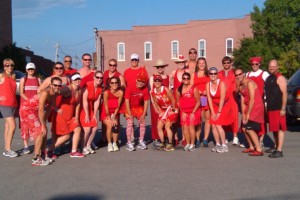
Marathon morning began with our hotel wake up call at 4:45 AM. The weather forecast was calling for partly cloudy skies with a temperature in the 60s at the starting line, 30s at the summit and 70s at the finish. With the fog and rain the day before, marathon morning was offering beautiful mountain weather. We collected the items we would need for the run, including fluids, energy gels, sunscreen and sunglasses. A quick bite at Denny’s, and we were off to the starting line. The sun began to rise as we drove to Manitou Springs, lighting the top of Pikes Peak in a brilliant orange glow. Beneath the peak, there were a few wispy clouds that had settled into the alpine valleys just below treeline. The deep blue sky framed the orange peak, the silvery clouds and the dark green forests as the scene dominated the western horizon ahead of us as we approached the marathon. Once there, we joined the crowd of runners, all lining up for pictures with the mountain in the background and the starting line banner in the foreground. I bumped into a couple of runners I knew and we too posed for pictures in the crisp morning air. We were just a few moments before the starting time, and we felt the excitement rising.
The Pikes Peak Marathon starts and finishes in the town of Manitou Springs, just outside of Colorado Springs. The course climbs from town up to the Barr Trail. The Barr Trail is an approximate 12-mile path that winds its way from the base of the mountain, up over Mount Manitou and then up Pikes Peak to the summit. The trail includes over 250 switchbacks, large boulders and roots, scree fields, dense forests, streams, mountain and valley views, vast boulder-strewn expanses above treeline, and several structures built at different times during Pikes Peak’s recent history. Many of these landmarks serve to mark the runner or climber’s progress up the trail towards the summit. While there are also mile and elevation markers, marking progress by miles is fraught with problems. Running up the Barr Trail, with its changing grade, terrain, available oxygen and topography forces the runner substantially to vary pace at different places. The effort required to run the first mile at a given pace is very different from the effort required to run the twelfth mile at the same pace. Carpenter’s advice is to determine a goal time to the summit and then use race statistics from over the years to determine approximately how long it would take to reach certain landmarks. To help with this, his website offers a calculator which estimates landmark-based intervals. Using the calculator, the time to reach the landmark known as Barr Camp, a structure about halfway into the run and 10 000 feet above sea level would take 50.8% of the ascent, or just over two hours for a four-hour ascent. Armed with the expected times to the various landmarks along the way up, the runner should be able to adjust their pace so as not to run too fast or too slow.
The approach to the Pikes Peak summit includes several other landmarks indicating how far you have gone in terms of a percentage of the total effort to reach the top. Estimating when you should pass each landmark requires that you have an idea how long it would take to get to the turnaround point at the top, 13.32 miles into the run. Having never run the Pikes Peak Marathon, I did not know the appropriate time it would take me to reach the summit given my abilities. The common rule of thumb is that, for flatlanders like me, getting to the summit takes your best recent marathon time plus 30 minutes. For example, if you can comfortably run a four-hour standard marathon and you have adequately trained for Pikes Peak, you should be able to reach the halfway point near the summit in about four hours thirty minutes. Getting back down to the finish line requires another 60% of the summit ascent time. I had completed my last fastest marathon in 3:50, which would predict 4:20 to the summit and a little over 7:00 to complete the marathon according to Carpenter’s calculator. Given that the average male finisher time over the past few years was 7:06, I decided to shoot for a finish time of 7:00 or less. To achieve a 7:00 marathon, and assuming that I would follow the split schedule as predicted, I would need to summit by 4:18. No problem, right? So I wrote down a pacing chart that included the major landmarks along the way, and the times I should reach them if I were to run a 7:00 marathon. I also wrote down the times for a 6:30 marathon, just for kicks.
Given that the thin mountain air would become even more sparse as I climbed the mountain, I elected to use my heart rate to help guide my marathon effort. This would supplement other information I had while running, including my general sense of wellbeing, the strength I perceived in my legs, my thirst and my hunger. I planned to maintain a heart rate between 155-165, which should represent a sustainable effort. In addition, given the tough incline that I would have to climb, my heart rate would serve as a guide for when I could speed up and, more importantly, when I needed to slow down or walk. However, I also knew that the altitude and thin air could cause my heart rate to climb higher or, weaken my effort to the point where my heart rate would drop lower. My monitor included GPS capabilities, so it would help me gauge distance covered and elevation above sea level. These data would be equally useful to help me monitor progress both in terms of linear distance and climb up the mountain. I could use the information to check off every altitude landmark as I ascended from 6300 feet to 14 050 feet, and again as I descended.
The race started in the heart of scenic Manitou Springs. There, with a couple of minutes to go before the start, the race director made the usual announcements to inspire us and make sure we understood the rules of the road. Then, a choir of school children sang “America the Beautiful”, which was inspired by Pikes Peak itself, and was written after the song’s author, Katharine Lee Bates, visited there in 1893. The singing before any race can evoke an emotional response, but standing there with the Pikes Peak summit in sight on a beautiful and cool Colorado morning after months of preparation and angst, I became choked up. My sunglasses hid tears of joy, excitement and nerves as the children sang and the crowd grew silent, just seconds before the starting gun. And then, “on your mark, get set, go”, a gun shot into the air, and we were off.
***
Oxygen is Overrated –
The first section of the Pikes Peak Marathon course goes through the center of Manitou Springs, along Manitou Avenue and among hundreds of cheering spectators, then veers left up to Ruxton Street and Hydro Street as it makes its way up to the trail. On the side of the road, Trish, who ran the Ascent and who is the wife of one of the runners in our group, was cheering us all on and calling out our names as we went by. Another spectator was blasting the tune from Chariots of Fire (a movie more about fast short distance running, but no matter, it is always inspirational). While running, the field thinned just a bit, and many people quickly passed me. I had been warned to take it easy and let folks pass; either they had the ability to maintain their pace, or they would quickly burn out on the long road ahead. The morning remained cool as we progressed up the hill towards the Barr Trail. My times to the first two landmarks were ahead of schedule: 4:37 minutes:seconds to Ruxton versus 5:17 for a 6 hour 30 minute run, or 5:41 for a 7 hour run (herinafter listed as actual time/6:30 finish predicted split/7:00 predicted split, or 4:37/5:17/5:41 for Ruxton, then 14/15/16 for Hydro Street). I was ahead of schedule, and felt good and light. My heart rate was right at 160, I felt air in my lungs, my thinking was clear and my legs felt pretty limber. A good start, and I hoped it was sustainable.
Shortly after passing the Cog Railway, a railroad that carries tourists up and down from the Pikes Peak summit, we turned right and entered the trail. The trail begins with a series of thirteen switchbacks, known as “The Ws” because of their appearance as stacked Ws on a map. There is one aid station at the bottom, and another just below the top of the Ws. The trail itself is made up of a narrow, single track path with rocks, roots and steep sides that all together make passing prohibitive. The term single track means that the trail is wide enough for a single runner only, and at times the designation seemed to have been an exaggeration, so narrow is the Barr Trail. Much of the trail on this section is also steep as it traverses through a dense conifer forest, still misty with the morning humidity. On this section, many of the runners were vying for position, passing each other when they could barely squeeze by. I passed a few people in this section, and other runners passed me. At the top of the Ws, after taking some Gatorade Endurance Formula and some grapes at the aid station, I found myself even more ahead of schedule, 43/48/52. At this point, I did not feel quite as strong from the recent climb, but my heart rate remained in my target zone and my thinking remained clear. So on I went.
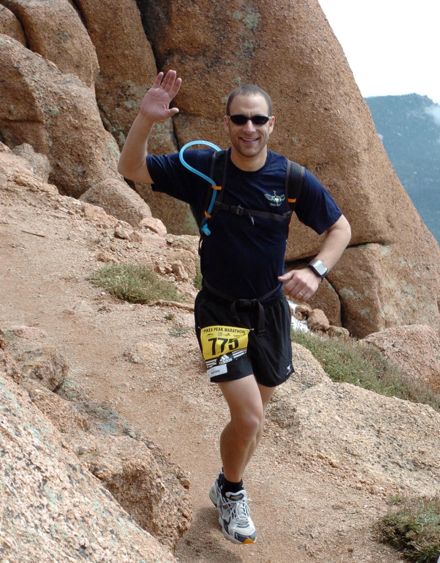
The next portion of the route winds through the woods and includes a few small climbs, switchbacks and flat sections. In this part of the marathon it is fairly easy to establish a running rhythm and simply to float on through. The hills often required fast walking to climb, but the flats really allowed some smooth running. During this part of the run you get your first glimpse of Pikes Peak. In the hour that had passed since the start of the run, the Peak had become even more spectacular. At this point, it filled the view, framed by the dense green forest and the large granite boulders jutting out above the trees. Some wispy clouds remained in the valleys above and below, and the sun was at just the right angle to illuminate the entire scene. As we ran through the hills below Mount Manitou, in the foothills of Pikes Peak, the views were continually breathtaking. I almost stopped on several occasions to dig out my camera and take pictures, always a great temptation for me, but I was still feeling good and wanted to press on. Shortly after ducking under a natural granite stone arch and climbing another hill, I reached the next landmark, the No Name Creek and aid station: 1:05/1:10/1:15 hours:minutes. I was still ahead of schedule, my heart rate still in zone, and I felt reasonably good. I drank some fluids, ate some grapes and energy gel, and then moved on.
Above No Name Creek, the trail climbs higher through more woods and includes a traverse over to Pikes Peak proper. This section ends at the Barr Camp, an old lodge on the mountain. According to the calculated splits, runners should reach Barr Camp in just over 50% of their total ascent time. As before, this section mostly winds through the forest, over generally well-kept trails of dirt and gravel, with occasional tree roots and clusters of small to medium sized granite rocks. The technical quality of the trail and the climbing grade forces the runner to pay attention with every step. There are occasional views of the mountain above in the clear open sky, and the city below, now mostly enshrouded in low-lying clouds. At this point, the running field had thinned considerably, and you could see only a handful of runners ahead and behind you. Passing runners was fairly uncommon at this point, although it did occur at the aid stations along the way. As I climbed higher, I began to notice that my legs felt heavier and heavier and that I began to feel weaker. I was not lightheaded. I was not nauseous. I was not dizzy. Mostly I just felt tired and a bit sluggish. I remained ahead of schedule, but by a shrinking margin: 1:30/1:35/1:42 to the sign that says 7.8 miles to the summit, and then 2:00/2:01/2:11 to Barr Camp. My heart rate had begun to drift lower at this point, and now mostly rested in the high 150s, suggesting that my actual effort was dropping while my perceived effort was increasing. But I pressed on. Just past Barr Camp was the seven mile marker, and my elevation was just over 10 000 feet. I was more than halfway to the top, and still moving forward
The trip from Barr Camp to the treeline is the trail section where most runners really feel the air thin, the elevation climb, their legs slow and their heads spin. There are numerous switchbacks, steepening climbs, and more obstacles on the trail. The trees remain dense, but the clearings come more frequently, the pines become more stunted and scrubby, and large orange-red and white flecked Amanita Muscaria mushrooms are everywhere along the forest floor. Here, those marathoners who are still running finally begin to walk, and the rest of the field begins to walk more slowly and with more attention to pushing each foot ahead. Step by step. The trees begin to thin and the bright sun becomes more intense. From here, hydration, sun protection and determination all become more important. I continued to push forward, but by this point my legs had begun to feel notably heavier, while my heart rate remained in the mid to high 150s. The elevation gauge on my GPS device kept climbing, which was a reassuring sign. But the work was beginning to get hard, and I began to feel the first thoughts of despair: What am I doing? Can I finish this? As I approached the treeline, marked by an A Frame cabin and another aid station the leader, Matt Carpenter, came flying back downward towards his finish. He appeared as something between a gazelle and a sparrow. And then he was gone and my climb continued. I made it to the A Frame somewhat slowed, but still ahead of my schedule: 2:55/2:50/3:03. The A Frame is at an elevation of about 12 000 feet above sea level, and just below the spot where the trees gave way to the tundra and open boulder fields that continued all the way to the summit. I stopped, took some deep breaths, a few cups of fluid, some energy gel, some Jelly Bellies (yum!) and some grapes. After a minute or two I felt a bit refreshed, and took off to complete the last three miles of the upward climb. Past an old burnt forest marked by barren weathered tree trunks interspersed with scraggly pines, and I was above the treeline. By definition, trees do not grow in the conditions above treeline. My wife has commented that there must be a lesson in this fact.
The rules change above treeline. That’s the general dogma for climbing or running up mountains. In this case, that means all the pace plans go away and any forward motion towards the summit is good. Climbing the remaining 2000 feet of elevation in over three miles to complete the climb up the Barr Trail generally takes the ascenteur far more time and effort than anything that came before. Add to that steep switchbacks which do little to flatten the climb, closely placed boulders that you must slow to climb over and substantially thinned air, and there was no good way to predict how long this section would take. Even the fastest runners struggle here, and nearly all of them walk or crawl. According to my schedule, it should take between 65 and 85 minutes to finish the climb. Along the way I would pass three major landmarks, each one attesting to my progress across the otherwise featureless rock field: the 2 miles to summit sign, the Cirque–a scenic view from a 1400 foot dropoff to the valley below–and the 16 Golden Stairs, a set of 16 switchback pairs just below the turnaround point. While these points indicate progress towards the summit, they also point out the runner’s ever-slowing pace.
On this morning above treeline there were large patches of fresh snow covering and surrounding the route, as well as snowmelt turning many trail sections into small streams. The air was cold, about 36 degrees according to the signs on the way up. A strong wind blew across the boulder field that made up our route, sometimes to our backs and sometimes to our fronts, as we zigzagged up the switchbacks. Looking forward I could see the summit, still appearing far away and high above, but now with a visible stream of marathoners winding up from where I was enduring my own struggle. Occasionally somebody ahead would call out, “runner” as one or more of the faster marathoners would come craning down the path, headed back to oxygen, the trees and the finish line. In the meantime, I was part of the slow march upwards. By this point, my heart rate was bouncing between 147 and 153, my legs were heavy as lead, and my head occasionally spun with exertion. I felt forced to take occasional breaks just to regain my focus and breath. At one of these a woman stopped, looked into my eyes and asked me if I was okay, and then did not seem to believe my reassurances that I was. But she eventually moved on and soon I too pushed forward. In most marathons, the runner begins to encounter a feeling of despair and doubt around mile 18 or 20, wondering just what they are doing running such a distance. During the Pikes Peak Marathon, I experienced this doubt around mile 11. But I had to push on and up. Slowly on and up I went. I made it to the 2 miles to summit sign still ahead of schedule, but just barely: 3:20/3:14/3:29. And then up past Cirque. And then up past a few switchbacks. At 3:50, two friends who were also running the marathon passed me on the way back down to the finish, both focused on the route and both appearing happy to be headed towards the air.
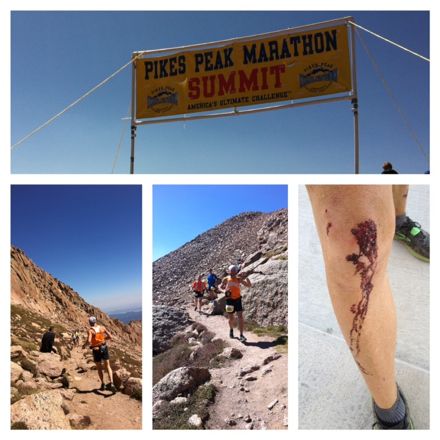
Soon it would be my turn to head down as well. I continued to traverse the steep stone fields. I passed more landmarks. One mile to go. Then the Golden Stairs. I counted them off, some switchbacks short, some long. I counted them, one, two, three, four, and so on. The rocks were slippery. Each switchback required a big effort to climb. I occasionally had to use my energy to move aside for a downhill runner. There was no air. My heart rate was dropping even lower, as my perceived effort continued to climb. But as I got closer to the summit there were people yelling and clapping and shouting encouragement. These were spectators who had driven up or taken the Cog Railway to witness the turnaround. Trish, who cheered us far below and long ago, was at the top again calling out my name and holding up a sign. Fifteen switchbacks, sixteen, seventeen. I could see the turnaround sign, hear the music, feel the top. Twenty six, twenty seven, twenty eight. And then, I was there. I reached the summit, took a few breaths of air, some fluids and grapes and looked down at the mountain. I made it right behind my goal time: 4:19/4:00/4:18. But that was fine; I hoped to make up that minute on the downhill. And so after one last look around, downward I went.
On the way down, within a few steps, runners suddenly can breathe, feel the strength return to their legs, and notice their heads clear. My experience was no different. I was barely below the Golden Steps and I felt like I was running a new race, albeit on tired legs. Now it was my turn to have the right of way; all the marathoners coming up moved to the side to allow me to come down. In my renewed excitement, I plummeted downward with near-wild abandon. Several other runners tentatively heading downward made room for me to pass as I flew by. I saw several friends headed upwards and I passed along the same encouragement I had received from downhill runners as I headed up. I was so excited to be moving that I stopped only briefly at the first few aid stations for fluids. And while some of the switchbacks and boulders required that I slow down, for the most part I found that I could run smoothly and consistently. My pace improved from approximately 15 minutes per mile on the more technical sections up high, to 12 minutes per mile as I passed below treeline, and then to 10ish minutes per mile below Barr Camp where oxygen awaited me. The trip down was great fun as I dodged the rocks, roots and ruts in the trail, passed numerous runners and vied for position with others, stopping occasionally to grab fluids and candy at the lower aid stations. There were a few small uphill sections that felt great on the way up the mountain, but were difficult on the way down; many of these we walked. The trail wound its way down all the switchbacks we had previously climbed, through dense forests and among light clearings, with occasional mountain and valley views to distract from the mounting fatigue. On the way down, I saw a few runners who had fallen while running at speed on the trail; many had gotten injured. One was covered in blood and bandages after receiving stitches for her injuries.
Heading downward, the time flew. I passed each mile marker, keeping a close eye on my watch and pace to make sure that I would reach my goal time of seven hours. At treeline, with ten miles to go, I had been running about a fifteen minute pace and had two hours remaining. I would not make it. Three miles later, at Barr Camp, I had seven miles and an hour and twenty minutes left, and was running at an increasing pace. I might make it. The further down I went and the more my pace increased, the more confidence I had that I would make it. In the last few miles, however, another factor emerged; it was becoming fairly hot and humid. I knew that I was sweating and losing fluids and salts. I stopped to drink more at every aid station, but my increasing pace made it hard to digest the fluids comfortably. I found myself in a tough place; as I descended, I began to cramp from the drinking, and began to feel a little weak from not drinking enough. I was close to the finish and ultimately decided that it was best just to push on. Fortunately, the aid stations were placed regularly enough that I could take small amounts of fluids frequently and keep an even pace. And I found the descent portion the easiest second half of a marathon I have ever run.
And so on I went, headed to the finish and hoping for a sub-goal time. Down past Barr Camp. Down across the traverse to Mount Manitou, then onto Mount Manitou and No Name Creek. I kept a close eye on my altimeter: 11 000 feet elevation, then 10 000, then 9000. Down through the granite natural arch. Down several switchbacks and some significant steep drops that I did not really remember from the climb. Down to 8000 feet. Then 7000 feet. Three miles to go, then two. Then the Ws, counting them down. At the bottom of the Ws, somebody was again playing Chariots of Fire. Then, immediately past this, one mile to go, and again I became choked up. And then asphalt. And then cones to guide us. And then a steep downhill. And then turn the corner to Ruxton Avenue. And then the crowds started to appear with kids waving for high fives. And again, Trish calling out my name and holding up a sign. Excited to be nearly done, I threw my Camelback to Trish so I would not have it in the finish line photo. And then down through the enclosing crowds and swelling cheers. There is my name and hometown being announced. And then around the corner, the finish line. And I was done. 6:48:17. Ahead of schedule and happy as can be.
– Trent Rosenbloom (2006)